nexttech.be
en

The knowledge platform for technology, innovation and digital transformation
In the future, warehouse managers will increasingly be able to rely on artificial intelligence (AI) when it comes to optimising material flow processes. During the technical showcase at the LogiMAT trade fair in Stuttgart, Linde Material Handling (MH) recently demonstrated how this product vision works and is gradually becoming a reality. The solution is based on NVIDIA's powerful Omniverse AI platform, which uses a ‘digital twin’ to collect, process and analyse vast amounts of data from warehouse operations in real time. This initiative is in line with Linde MH's parent company, the KION Group, which recently announced a large-scale collaboration with NVIDIA, a leader in AI, and Accenture, an expert in digitalisation, to take industrial automation to a new level.
At LogiMAT, Linde presented a scenario that could be typical for the warehouse of the future – manual and automated trucks working side by side in perfect harmony with the help of innovative AI technology. This development will be particularly beneficial for large truck fleets. The integration of intelligent hardware and software, combined with computing power, guarantees transparency of every process within the warehouse and ensures more efficient, reliable and flexible order processing through continuous simulation. “Artificial intelligence and neural networks will improve warehouse efficiency. Throughput will increase, both manual truck fleets and AGVs can be optimised, and personnel can be deployed more efficiently. This will lead to significant cost savings for companies,” says Ulrike Just, Member of the Executive Board and responsible for Linde MH Sales & Service EMEA. “As a leader in technology and innovation in our industry, we are at the forefront of developing AI-based solutions. These solutions represent a major breakthrough and are aimed at improving our customers” competitiveness and ensuring the long-term efficiency of their material flows. We are planning the first pilot projects with major customers, for whom the return on investment will be particularly high."
The first step in Linde MH's strategy is to make manual internal transport smarter by making it part of a network. That is why they are working on a new tracking system that shows exactly where each truck is located – both inside and outside the warehouse. This system uses modern technology that requires little additional equipment. Drivers receive route instructions and new assignments via a smart screen. The system takes into account the location of the truck and, for example, the position of the steering wheel. This allows the route to be adjusted immediately, for example if there is congestion somewhere, in order to avoid delays.
As warehouses become more complex, optimising routes and coordinating manual and automated internal transport places much higher demands on capacity. “When 100 or more trucks need to be coordinated, it is essential to use higher-level intelligence and hardware capable of processing such large amounts of data,” explains Ron Winkler, Managing Director of the Digital Business Unit at Linde MH. “This is where AI from the NVIDIA Omniverse platform comes in. It creates a digital twin of the warehouse, a virtual 1:1 replica of the physical environment.” In this digital twin, simulations can be run in fractions of a second – either to optimise routes and coordinate AGVs and manual trucks optimally, or to realise optimisations in existing warehouse layouts.
The main advantage is that solutions for changing warehouse conditions, such as new orders or stock fluctuations, traffic jams in certain warehouse areas, obstacles or overhanging loads, can be identified in real time, simulated in the digital twin and sent back to the truck control system. For example, if a truck arrives late, the system can automatically assign the nearest forklift to unload. To achieve this, the NVIDIA Omniverse platform digitally stores all physical data relating to internal transport (e.g. load capacity, steering angle) and infrastructure (e.g. rack locations, routes, working hours). This virtual space then processes the constant flow of information from sensors, intelligent truck and infrastructure cameras, warehouse management software and truck control systems.
Intelligent camera systems, strategically installed throughout the warehouse infrastructure and on both manual and automated trucks, are used to track load carriers, AMRs and manual trucks. They also provide real-time monitoring of loading and storage areas. The images captured by these systems are then immediately interpreted and processed by AI.
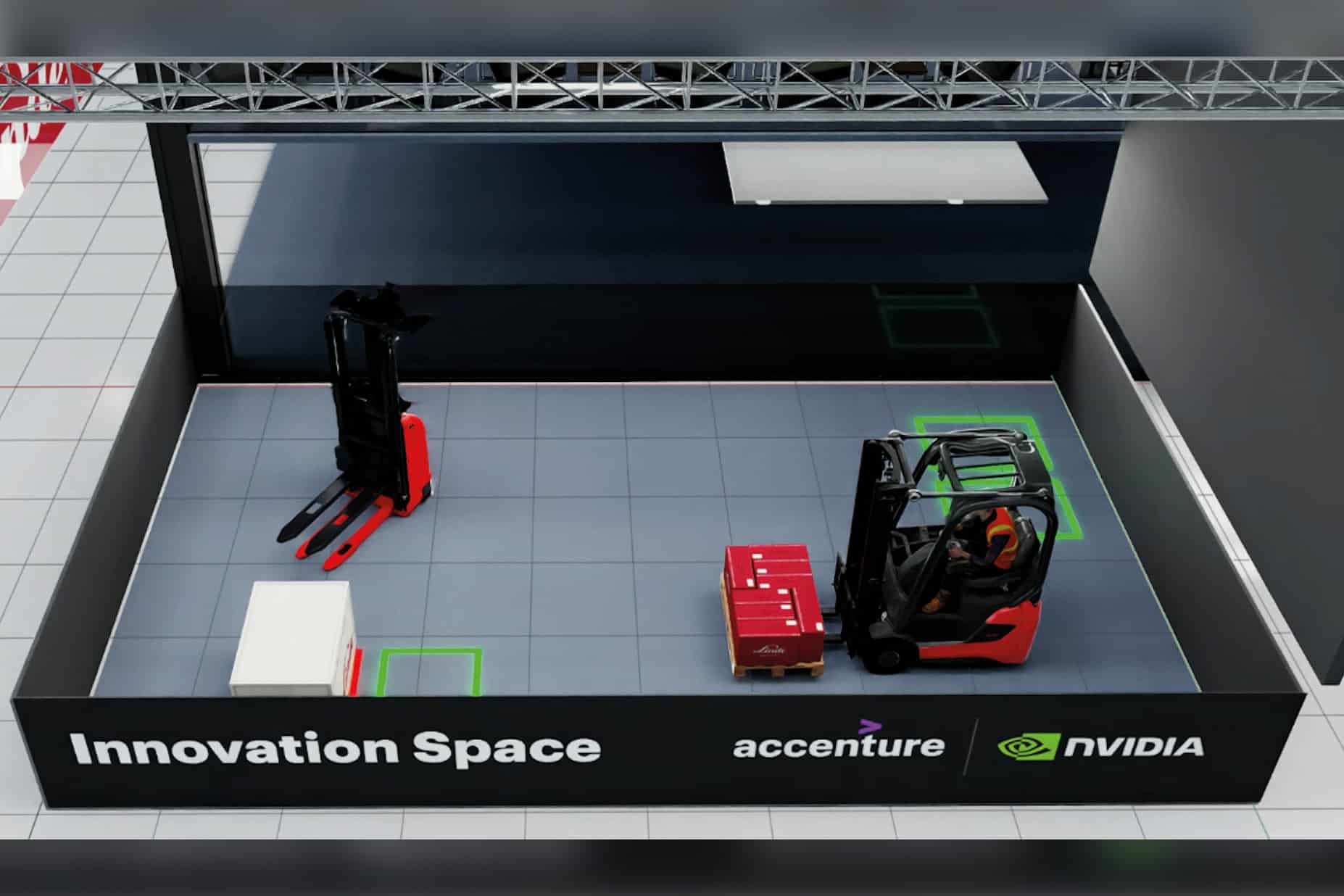
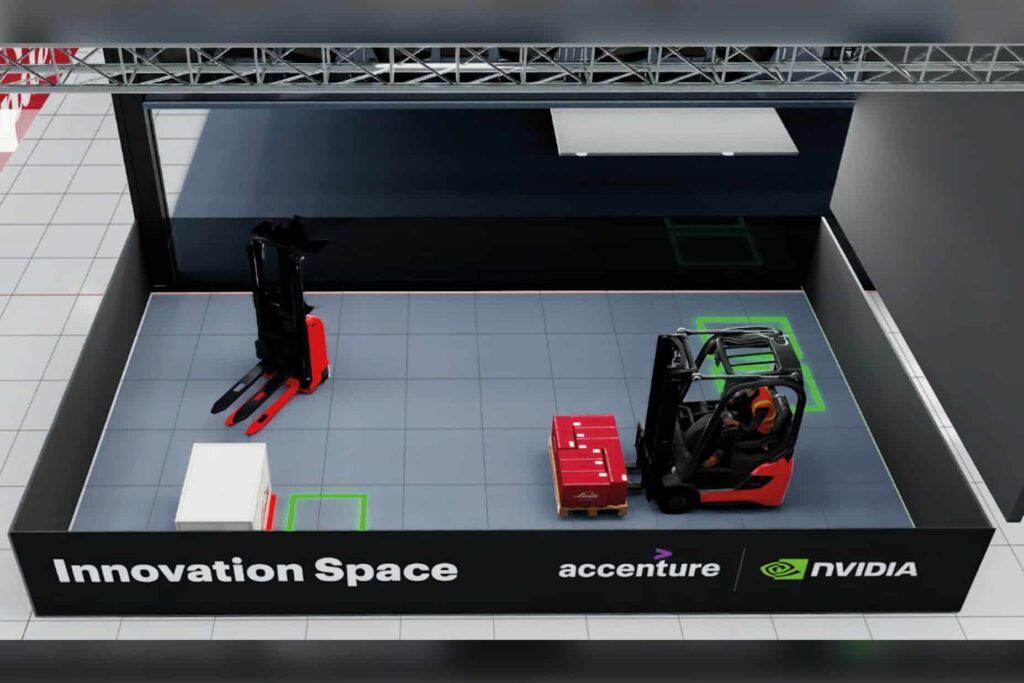
The showcase at the Linde stand demonstrated this in practice: a forklift driver transports goods to the receiving area with an electric Linde forklift. In the designated transfer area, a fully automated Linde stacker then picks up the pallet for further transport to the warehouse. To enable seamless documentation and tracking of materials and goods on the Omniverse platform, the mobile, intelligent camera on the manual truck automatically takes a photo of the load when the pallet is picked up and stores it in the system. At the same time, the camera records the entire environment, identifies people and obstacles, and immediately adapts the truck's behaviour to the situation. The cameras in the warehouse provide the system with information about the occupancy of the storage locations and also detect possible collisions with people, which would require the trucks to slow down.
But what if the forklift driver does not place the pallet exactly on the specified surface, as an AGV usually requires? Using the cameras, the digital twin recognises the placement of the pallet and sends the order to the Linde L-MATIC core. Thanks to the intelligent camera on the fully automatic AGV, AI detects the tilted pallet and determines a solution – in this case, the best way to pick up the load. The cameras also signal problems such as boxes slipping or part of the load overhanging. In such cases, AI concludes that the AGV should not pick up the load. The Linde L-MATIC core then stops and is assigned to another transport task. Meanwhile, AI calculates which manual truck is nearby to take over the transport task.
“By configuring a digital twin of the warehouse, every conceivable infrastructure and fleet configuration can be simulated in 3D and tested for efficiency,” explains Ron Winkler. “AI can be continuously trained and refined. This forms the basis for a warehouse system that proactively solves challenges and keeps getting better.”