nexttech.be
en

The knowledge platform for technology, innovation and digital transformation
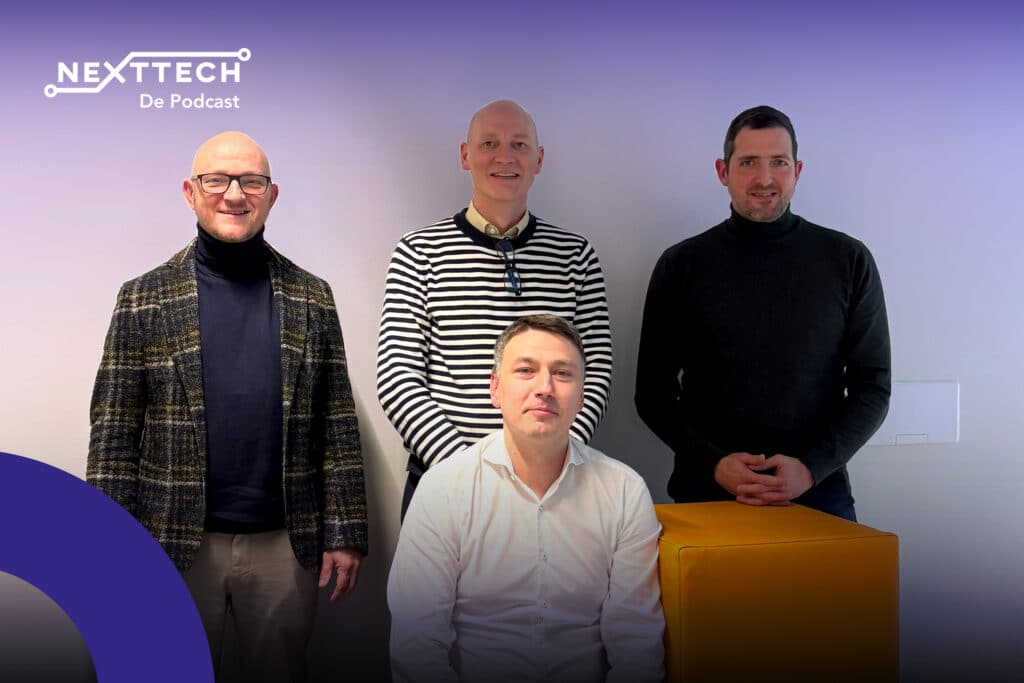
Welcome to the very first NextTech podcast.
We all know that our manufacturing industry is currently struggling. But Flemish entrepreneurs are persevering nonetheless. The evolution of digitisation, Industry 4.0, electrification and sustainability is increasingly putting companies on the path to a smart, data-driven economy.
• Pieter-Jan De Man (Director of STAS & Squadron)
• Björn De Vidts (Chief Executive Officer of the Flemish data utility company Athumi)
• Alexander Dewaele (Louwers Media Group)
NextTech Podcast – Episode 1
Host: Björn Crul
Guests:
– Pieter-Jan De Man, Director of STAS & Squadron
– Björn De Vidts, Chief Executive Officer of Athumi (Flemish data utility company)
– Alexander Dewaele, Louwers Media Group
Björn Crul – [00:01]
Welcome, everyone, to the very first NextTech podcast. We all know that our manufacturing industry is currently struggling. And yet Flemish entrepreneurs are persevering. The evolution of digitalisation, Industry 4.0, electrification and sustainability is increasingly putting companies on the path to a smart, data-driven economy.
And that is what I want to discuss today with three experts from the field: Pieter-Jan De Man, director at STAS and Squadron, Björn De Vidts, CEO of the Flemish data utility company Athumi, and Alexander Dewaele from Louwers Mediagroep.
Gentlemen, welcome. Yes, Pieter-Jan, when we talk about smart manufacturing, I think there is no one better than you to testify about it from the front line.
Two STAS factories where you manufacture tippers and self-unloaders have been awarded the label. Factory of the Future – a rather prestigious award, granted by Agoria, the technology federation, and the Sirris research centre. How did you achieve this? What had to be done in your factories to attain this status?
Pieter-Jan De Man – [01:06]
It is a combination of technologies: digitisation, automation, a smart way of engineering, combined with a human-centred approach. That human-centred approach in combination with technology basically says: can we ensure that we effectively implement the technology that is available? In such a way that everyone – employees, operators, clerks, management – makes use of it.
We have always focused on these two priorities: incorporating technology and ensuring that it becomes embedded.
Björn Crul – [01:46]
You are quite advanced in this area in Flanders. Could you provide a specific example of how people and technology reinforce each other?
Pieter-Jan – [01:55]
Certainly. We start with a configurator. A vehicle can be configured anywhere in Europe. Without the salesperson seeing it, he loads the operator's work instructions. When that vehicle goes into production four weeks later, the operator receives his instructions. He can also write off the material and submit his leave request and see how many leave days he has left.
Björn Crul – [02:22]
To what extent should these operators be digitally savvy? What should they be able to work with?
Pieter-Jan – [02:30]
They must be able to operate a smartphone, I always say. We do not believe that everyone should become an engineer; that would never work. We deliberately make the software very simple: a green start button, a red stop button. That way, any operator can get started with it.
Björn Crul – [02:48]
You first obtained that label years ago. Now two factories are certified. Isn't it difficult to keep improving when you already have such a high status?
Pieter-Jan – [03:02]
Yes and no. On the one hand, there is a solid foundation, which allows you to build on it more quickly. On the other hand, it remains work in progress, because relabelling involves re-examining effective progress over the last three years. It is not your overall progress that counts, but what you have recently innovated.
Björn Crul – [03:32]
You are firmly established in Flanders and Belgium. How do you explain that success, when many captains of industry say that industry is difficult here?
Pieter-Jan – [03:50]
On the one hand, we have been around for almost 130 years – we are well established in West Flanders. On the other hand, we keep the share of direct and indirect labour costs in the total cost of a trailer low. If that share becomes too high, we are at a significant disadvantage in Belgium. That is why we focus strongly on technology.
Björn Crul – [04:20]
Hence the important role played by technology.
Pieter-Jan – [04:23]
Exactly.
Björn Crul – [04:28]
The challenge is to combine talent and technology. And that's where data comes in. Björn De Vidts, you are the CEO of Athumi. In a nutshell, what is your role as a Flemish data utility company?
Björn De Vidts – [04:51]
Athumi is the data utility company for Flanders. You could compare us to utility companies that supply gas, electricity or telecommunications – but we supply data services.
On top of the internet, we offer a neutral data layer that enables collaboration between companies and sectors without them losing their independence. This requires a neutral party, which until recently did not exist.
Europe officially recognises us: we cannot have any business interest in the data that is shared. We cannot become the owner of the data shared via Athumi. This creates the necessary trust to work with sensitive data.
Björn Crul – [06:04]
People say that data is the new gold or the new oil. Why is data becoming so important?
Björn De Vidts – [06:18]
Data is becoming a fully-fledged factor of production in industry, alongside labour, energy and capital. At the same time, technologies such as AI, automation and digital twins are capable of generating ever-increasing amounts of data.
This makes it possible to predict, optimise and personalise products and services.
A second trend is that Europe is pushing towards a single data market through regulation. This makes data an asset, especially in the manufacturing industry, where operational data has a huge impact on quality and efficiency.
Björn Crul – [07:34]
Pieter-Jan, I saw you nodding.
Pieter-Jan – [07:39]
We have developed our technology in-house, so we manage our own data. That is a significant advantage. We can quickly leverage the data that comes in.
Björn Crul – [08:06]
Are companies already convinced that this is the future?
Björn De Vidts – [08:24]
Absolutely. Athumi currently works with around 6,200 companies and SMEs.
This year, we are aiming for 20 million transactions – a third more than last year. Our clearinghouse activities are increasing by 60%.
This demonstrates that companies recognise that data is an asset and that collaboration is becoming essential, particularly in sectors with small margins.
Björn Crul – [09:45]
Cooperation with the government is also crucial.
Björn De Vidts – [09:51]
That's right. The government manages a lot of critical data well, but it is difficult to make it accessible to the private sector.
Two-thirds of our 90 data streams originate from the public sector. We ensure that the data can be shared in a compliant and secure manner, which increases trust on both sides.
Björn Crul – [11:22]
Do you have a good case study from the industry?
Björn De Vidts – [11:22]
Yes. KPMG estimated our economic impact at nearly 90 million euros: 14 million in the public sector and the rest in the private sector.
We operate in sectors such as real estate, media, and human resources. We consistently opt for concrete, tangible business cases.
Björn Crul – [12:35]
Pieter-Jan, for many SMEs, digitisation is still a big step. Is that what Squadron is focusing on?
Pieter-Jan – [12:55]
That's right. The technology is available, but what is often lacking is strategic insight: what exactly can I do with digitisation or data?
In addition, we see solutions that have not been developed to the point where they can be used by employees, meaning that they are only half utilised.
We support customers in these two key areas.
Björn Crul – [13:47]
Alexander, are you hearing the same thing in the market through Louwers Mediagroep?
Alexander – [14:07]
Yes. The question is not whether companies will digitise, but when and how quickly. It provides insights, efficiency and competitive advantage.
Björn Crul – [14:28]
What expertise does Squadron bring to the table?
Pieter-Jan – [14:43]
We focus on digitising the entire process – from sales and marketing to after-sales service – and on automation, specifically welding automation.
In addition, heavy work is replaced by robots and the operator is given a lighter set of tasks.
Björn Crul – [15:14]
This should help to anchor the manufacturing industry here.
Pieter-Jan – [15:21]
Of course. A project is only successful if there is a return that has been calculated in advance.
The demographic trend is negative. The war for talent has only just begun. Technology is the solution.
Björn Crul – [15:53]
Björn, cooperation across company boundaries is essential. How difficult is that in Flanders?
Björn De Vidts – [16:17]
Not easy. The reflex is: “I'll do it myself.”
But the most difficult hurdle is trust: who can see my data, what risks am I running, what are the legal implications?
Companies already struggle with their own compliance. That is why we make compliance our absolute priority.
Björn Crul – [18:34]
Do you have an example of a successful ecosystem?
Björn De Vidts – [18:52]
The property sector. We have built a data highway between the government and property professionals.
Whereas in the past one had to consult dozens of sources, everything is now available in a standardised format.
It saves time, reduces costs and increases competitiveness.
Björn Crul – [19:58]
What is the most important lever?
Björn De Vidts – [20:06]
Trust and neutrality. No dominant party, strong governance, sustainable financing, value for every member, and compliance with European rules so that it can scale up.
Björn Crul – [22:02]
Pieter-Jan, does your ecosystem with Squadron also benefit STAS?
Pieter-Jan – [22:19]
Yes. You can't know everything yourself. Every customer benefits from the previous 70 projects. STAS too.
Björn Crul – [22:54]
Alexander, what do you see happening when companies are brought together?
Alexander – [23:09]
It creates a collective brain. Individuals sometimes fall short, but together, more focused ideas are formed. It keeps participants sharp and leads to better outcomes.
Björn Crul – [23:43]
Pieter-Jan, what trends will shape our smart industry in the coming years?
Pieter-Jan – [24:00]
AI. But only when the right use cases are found. The technology and data are there. Now we are looking for real added value.
Björn Crul – [24:38]
Björn, AI is also your domain.
Björn De Vidts – [24:42]
Certainly. AI makes access to strategic data crucial. Flanders has everything it needs to become one of the best-connected data regions.
Legislation is an opportunity for new business models, not a threat.
Björn Crul – [25:48]
Alexander, what can we expect from the new NextTech platform?
Alexander – [26:06]
We observed the same patterns in several sectors: automation, digitisation, robotisation.
With NextTech, we bring all of this together and build a community.
Official launch: today.
Björn Crul – [26:39]
Very well. Unfortunately, our time is up. Thank you for this pleasant conversation, Pieter-Jan De Man, Björn De Vidts, and Alexander Dewaele.
And you, dear listener, thank you for joining us. Follow everything related to NextTech via Louwers Mediagroep's social media channels. See you soon.