nexttech.be
en

The knowledge platform for technology, innovation and digital transformation
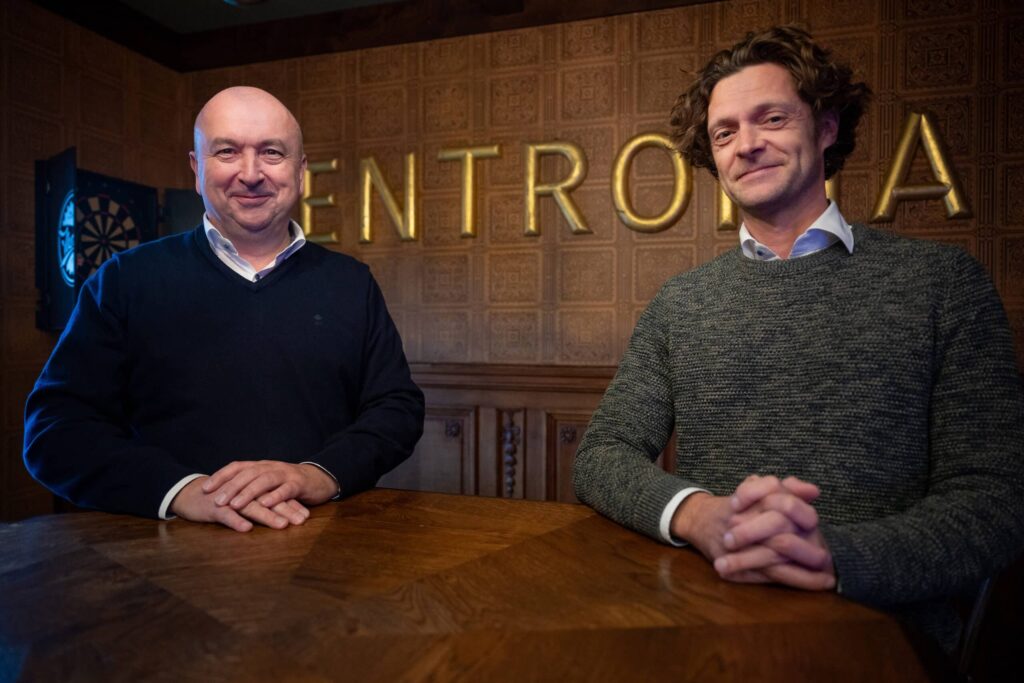
Conquering the world from Flanders is not something every company can achieve. Even for technology companies, it remains a struggle to secure a place in foreign markets. Entropia from Oostkamp, which specialises in systems and services for mission-critical communication, and Sensolus from Ghent, which enables companies to monitor their machines, vehicles and assets via an IoT platform, prove that it can be done. Company directors Philip Vercruysse and Kristoff Van Rattinghe talk about the steady expansion of a Belgian multinational and their ambitious growth plans.

Philip Vercruysse: I started a shop in the Bruges region over 35 years ago, selling communication equipment to radio amateurs and small businesses. However, I was soon confronted with questions from professionals looking for specific solutions for wireless communication, such as police and shipping services, coastguard, water and energy companies, and so on. This led to some great projects, during which I realised that there was also a need for a reliable network for mission-critical communication, separate from the traditional mobile networks. This is how the first Entropia network with microwave links came into being in West Flanders. At the instigation of our customers, we systematically expanded this from 2000 onwards to achieve full coverage in Flanders and Brussels. In a later phase, networks were added in the Netherlands, Great Britain and offshore in the North Sea. We continue to perfect our technology and offer very high ‘availability’. As an SME, we currently have a turnover of 10 million euros with 35 employees.
Kristoff Van Rattinghe: At Sensolus, we started 11 years ago with the idea that the Internet of Things offered a very simple solution for digitising all kinds of things. This enabled us to offer non-technical users a wide range of possibilities without the need for heavy investment in hardware. Our first projects involved informal care and remote monitoring of loved ones. Over time, we opted for industrial asset management, i.e. remote monitoring of valuable equipment. Our customers are typically large companies such as Airbus, DHL and Volvo. In 2016, we launched in neighbouring countries France, Germany and Great Britain. We also deliver in Spain and Italy through partners. Sensolus now has 55 employees and our turnover will reach the €10 million mark in 2025.
Philip Vercruysse: We want to continue growing step by step, as we have always done. We receive enquiries from many countries, but the nature of our services – guaranteeing mission-critical communication that works at all times – requires us to focus. We have just implemented a nationwide switch upgrade on our network so that we are ready for simultaneous hybrid techniques on TETRA and 5G technology. In addition, we have developed the Combonet platform ourselves, which allows us to provide services such as 5G broadband communication, even in countries where we do not have our own masts. We are already working this way in the United Kingdom, and our Dutch colleagues want to grow in Germany in the same way. And finally, we have also devised the mission-critical ComBus platform: a control room platform that not only provides mission-critical voice and data dispatching, but also controls and operates telemetry. All this via our own masts, our own infrastructure and our own cloud environment.

Kristoff Van Rattinghe: We use public networks to connect sensors to our SaaS platform. This means we don't need any fixed infrastructure. It also means we can scale quickly, from 5 to 10,000 sensors. 80% of our turnover now comes from abroad. But every additional country presents a new challenge. Because no matter how good your product is, you need time to get to know the local business culture and customs. That's why we deliberately work with local teams who put us on the market locally. After neighbouring countries, we took the step to the US in 2022. That is, of course, a large, lucrative market with many opportunities, but you can also burn through a lot of money there quickly. In fact, it's 50 separate countries: each state has its own character. We are steadily looking for ways to grow, with a local duo: a Belgian expat and an American with a lot of experience in the tech sector. After two years, we already know much better what works and what doesn't. It's a hugely exciting experience, both for the company and for me personally.
Philip Vercruysse: We have found a strategic partner who wants to work with us for the long term. Due to accounting and tax differences between Belgium and the Netherlands, the paperwork is currently being finalised. The aim is to fine-tune our financial structure from the past and then be able to invest heavily and grow. We are refining our existing network by making even greater use of dual beam connections, thereby also increasing redundancy so that we can continue to guarantee our service guarantee of at least 99.5% uptime. In addition, we will also offer customers terminal equipment, so that they no longer have to worry about this. And I certainly see opportunities to further expand our mission-critical ComBus cloud software. So there are plenty of plans.

Kristoff Van Rattinghe: As a growing company, you are always concerned with financing. We need to have sufficient resources to implement our strategy. Four years ago, a German industrial investment fund came on board, precisely to enable our internationalisation. Since then, we have raised additional funds through bank financing and existing shareholders. We are not ruling out new rounds of financing, but raising money should not be an end in itself. We see a lot of growth potential and we are ambitious, but at the moment there is no concrete need for additional financing.
Kristoff Van Rattinghe: That's a difficult question. When I'm in America, I see how many opportunities the start-up culture offers: there's money available, you can move quickly and everyone gets lots of chances according to the principle of ‘failing forward’. On the other hand, as a company, we would never have got as far as we have now if we hadn't had to grow cautiously in the early stages. What strikes me is Belgium's image abroad: we have well-trained engineers, extensive language skills and we are quiet, hard workers. These things give us a quality label abroad.
Philip Vercruysse: Doing business in Belgium is a challenge. The rules of the game for entrepreneurs change frequently here, but that also makes you stronger. I find that the spirit in the Netherlands is more straightforward, whereas innovation requires you to be able to think in a sufficiently chaotic way. I think Belgians have that in their genes. Sometimes the Dutch look down on the Belgians, until you achieve something great that they look up to. Where you do business may not make much difference, as long as you do it with passion and together with your employees.

Kristoff Van Rattinghe: I now take more time to lead strategic projects. With our team expanding to 55 employees, I don't have to concern myself as much with day-to-day operational matters. But my first priority remains staying close to people and ensuring internal communication, including with our employees abroad. It is the team that has to carry our plan forward and make it a reality. In addition, there are specific challenges such as new partnerships, a new major customer or brand awareness in the US, which I am committed to tackling. These issues keep the job interesting and ensure that I continue to learn as an entrepreneur.
Philip Vercruysse: I can totally relate to that. A while ago, we appointed a Dutch managing director, which meant that my role evolved more towards that of Chief Technology Officer. I remain fascinated by engineering and technology; that passion is still greater than “being CEO”. Now that we have secured growth financing, the sky is the limit in our niche market. We are already attracting new people and looking at opportunities for acquisitions that could strengthen our group. I see 2025 as the most innovative year in Entropia's history.