nexttech.be
en

The knowledge platform for technology, innovation and digital transformation
How sustainability creates competitive advantages
For the seventh time in a row, Siemens‘ Best Application Contest (BAC) is already highlighting the creativity and innovative strength of Belgian machine builders and integrators. This year's edition got off to a flying start: after just one month of campaigning, we already received almost ten strong cases. The spotlight is not on Siemens’ technology, but on the technical talent and innovative thinking of partners. This year, the BAC revolves around 'sustainable operations': dealing smartly with energy and raw materials.
As many as 13 cases competed for the public vote two years ago, which got its apotheosis during Indumation. “This year too, we are sticking to the fair for the presentation of the awards. After all, innovation is increasingly a story of partnerships. No better setting than a place where the entire sector is gathered. Finally, these showcases serve to inspire other customers as well. To show how Siemens technology can make the difference to operate more sustainably,” says digital marketer Joyce Gevaert, who puts her shoulders to the wheel at the BAC. In doing so, the BAC is not looking for greenwashing, but proven sustainability gains with Siemens technology at their heart. Like the story of Q-Pinch, which makes better use of waste heat from industrial cooling towers thanks to Siemens“ DCS system. ”For every kW of electricity consumed, the installation provides 35 kW of heat," Gevaert immediately gives a telling example.
The projects submitted this year must have one main goal: to make a process or application more sustainable. At Siemens, this means three pillars: decarbonisation and energy efficiency, resource efficiency and circularity, as well as impact on people and society. Siemens Sustainability Manager Katrien Valkiers says: “90% of our business enables our customers to have a positive sustainability impact.” She cites the example of a retrofit of a decoiling line at Decomecc. Thanks to a new electrical installation from Siemens, it now operates more economically and safely. “Before, the machine used
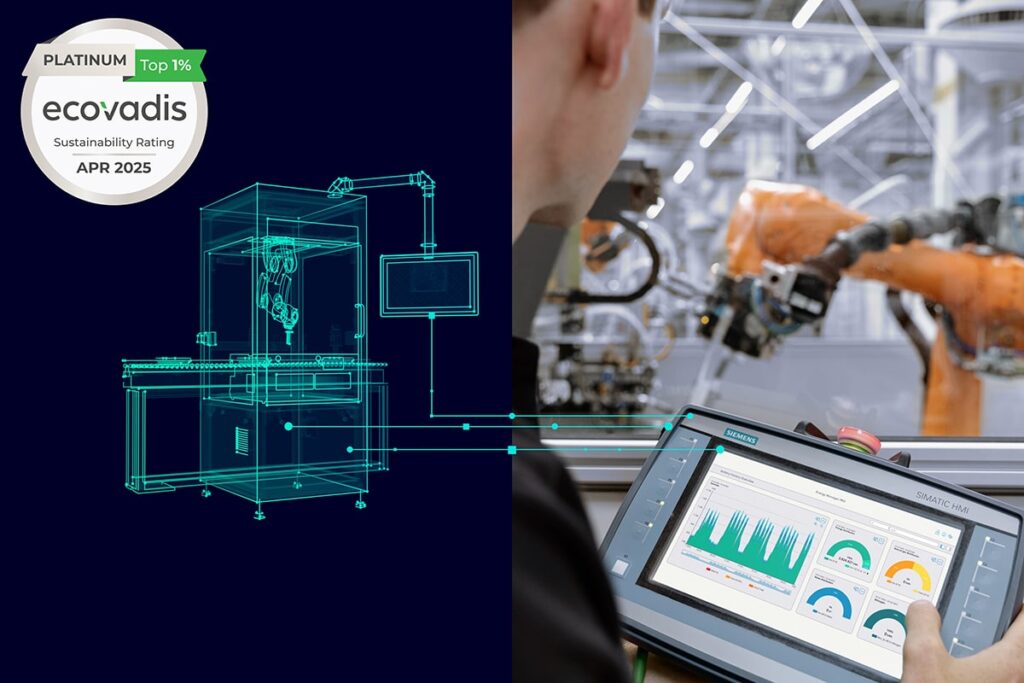
40 kW when she stood doing nothing, today still 1 to 1.5 kW. A great result. But of course we also sweep in front of our own door. For that, we have our strategic sustainability framework DEGREE, a set of 14 concrete, global ambitions for sustainability. The recent EcoVadis score of platinum, our highest ever, shows that we are on the right track.”
But is this really the time to highlight sustainability with the BAC? Many companies see the Green Deal from the previous European legislature rather as a green noose around their necks. Something Europe has come to realise by putting the brakes on a bit of its own implementation of those rules. Thierry Van Eeckhout, Head of Siemens Digital Industries Belgium: “As a company, we are convinced that sustainability is a strategic advantage. If you do the same as before, but with fewer raw materials, less water, less energy, you build a stronger competitive position for yourself. Being less dependent is always a good idea. So sustainability is not a matter of must and compliance, but common sense.”
But if you want to turn waste back into raw materials, you have to think about how you design and produce products in a completely different way. This is only possible with the necessary knowledge. The Siemens Industry Academy (SIA) was set up to link this knowledge with the field from school. Van Eeckhout: “Technology is only one side of the story, you also need people to implement it. It is up to us to inform customers about what is possible with new technology today. But we also try to make future generations already familiar with digital twins, IIoT, AI and machine learning. Automation and digitalisation really go hand in hand with sustainability.”
A great project that illustrates SIA's power to have social impact is Helicus“ Drone Cargo Port for the Jan Yperman Hospital in Ypres. This is the world's first automated drone airport that transports blood samples from A to B. SIA students built a digital twin to simulate the landing perfectly. ”Transport is now faster, more energy-efficient and unburdens staff, allowing them to focus more on patients. In the end, that's what it's all about," Van Eeckhout concludes.