nexttech.be
en

The knowledge platform for technology, innovation and digital transformation
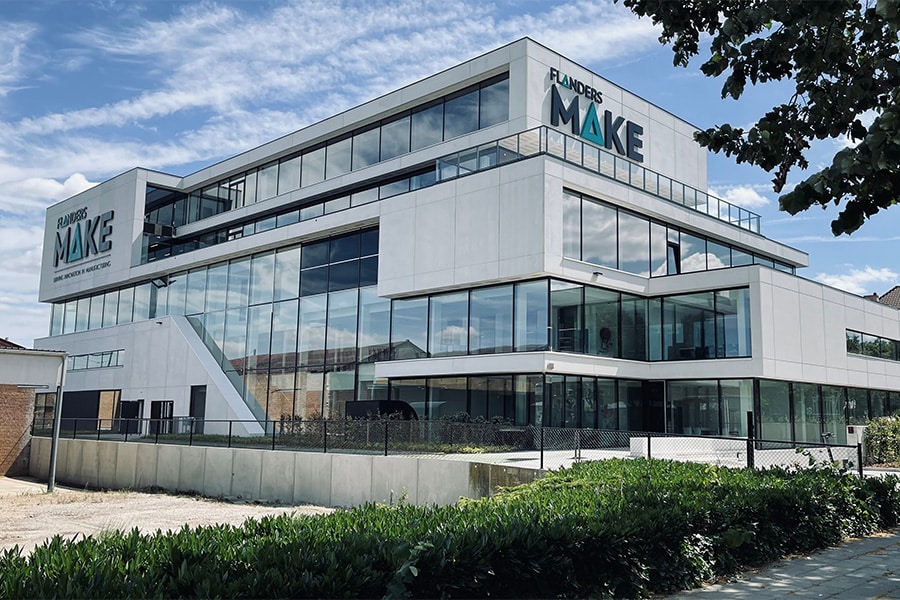
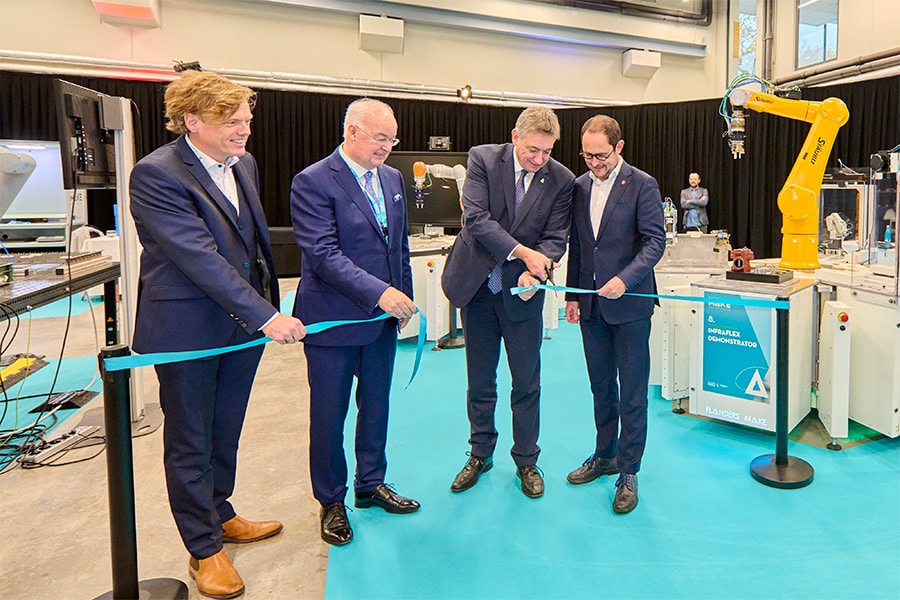
The new Flanders Make building in Kortrijk was opened on 9 November. Flemish minister-president Jan Jambon was handed the scissors fully automatic to officially cut the ribbon. Because instead of an investment in a pile of bricks (albeit beautifully modelled by the architectural firm Jasper Eyers), this is an investment in technology and people. It gives companies the space and the experts to develop and test out new production technology. The mission? To help companies switch to smart, flexible and sustainable production that makes single pieces as affordable as mass production.
A temple of technology. This is how Urbain Vandeurzen, chairman of Flanders Make's Board of Directors, described the vision they had in mind with the new site in Kortrijk. “Industry is the engine of our economy. We want to use a reindustrialisation strategy to raise its relative share back to 20%. Because when industry grows, so do employment rates and prosperity. With this building, we are laying a new cornerstone for that strategy. We want to build an ecosystem of innovation, where researchers and companies find each other in top notch technology. We are also housing our Flanders Make Academy here to introduce tomorrow's talents to the latest technologies.”
Whereas in Flanders Make Lommel and Leuven automotive and mechatronics respectively will be the focus, Flanders Make Kortrijk will concentrate on production technology for the manufacturing industry. “With an emphasis on Industrie 5.0,” Vandeurzen explains. “We no longer assume that everything can be digitised and automated. But that humans should be at the centre of this technology story. That it is the technology that should support him to accomplish his tasks better.” The new building will eventually house 150 researchers. Permanent space has also been set aside for companies to come and experiment with new technology. “We lease the building, the money we got from the Flemish government went mainly to equipment and technology,” Vandeurzen said.
This should not only provide innovation around manufacturing issues. “It is also our job to roll them out to enterprises. Here, we let both big players and SMEs experience how to make the best use of new technologies such as digital twins, smart robotisation and automation. We help them discover in a tangible way how to make a wide range of products in relatively small quantities in an efficient and sustainable way. Flanders Make is there for everyone, the only requirement is that the company has an innovation focus.”, says CEO Grisja Lobbestael.
For Flemish prime minister Jan Jambon, too, the path of innovation is the way forward. “If we succeeded in eliminating our CO emissions in Flanders, it would only be a drop in the ocean. After all, we only account for 0.025% of global emissions. But if we can develop and export the technology here to build a more sustainable world, only then are we going to have a real impact. And we need our fantastic research institutions to do that. They can drive that innovation. We have the necessary knowledge and skills in Flanders. We are now going to maximise this for the benefit of our large and small companies and society.”
For Mayor of Kortrijk, Vincent Van Quickenborne, West Flanders was a logical choice and Kortrijk the best possible one. “67% of the turnover generated by machine builders is done by West Flanders entrepreneurs. Five years ago when we cycled through the city, we didn't end up at this location by chance. Ghent University is here, Howest is on this site with the best gaming school in the whole world. Together they can be a flywheel for that innovation we need. And the fact that the building was erected here in five years shows that we can get somewhere with the West Flemish mentality,” he concludes with a wink.