nexttech.be
en

The knowledge platform for technology, innovation and digital transformation
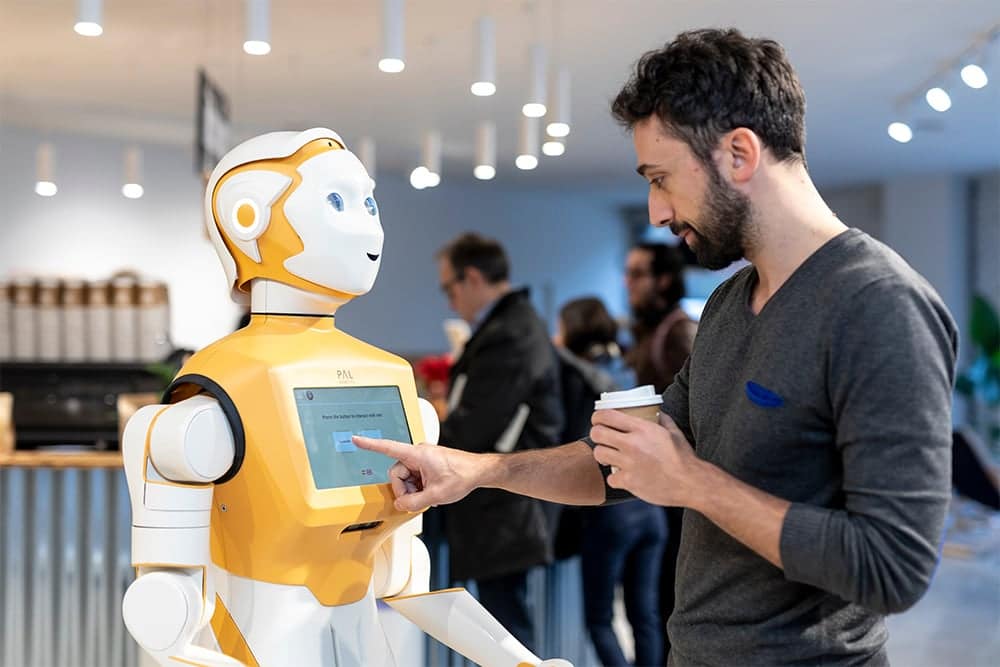
Every year, the number of robots in operation worldwide reaches new heights. Last year, it was clocked at
3.9 million units. Demand will be further driven in the coming years by a number of exciting technological innovations.
The use of artificial intelligence in robotics and automation is growing rapidly, especially with the advent of generative AI (GenAI). This subset of AI specialises in creating something new from things it has learned through training, and has been made popular by tools such as ChatGPT. Robot manufacturers are developing GenAI-based interfaces that allow users to programme robots more intuitively by using natural language instead of code. Even without programming skills, you can now select and customise the robot's actions.
Another example is predictive AI. This allows you to analyse data on robot performance to determine the future condition of equipment. In the automotive industry, every hour of unplanned downtime costs an estimated £1.3 million. This illustrates the enormous potential of predictive maintenance. Machine learning algorithms can also analyse data from multiple robots performing the same process for optimisation purposes.
Human-robot collaboration remains an important trend in robotics. Thanks to rapid advances in sensors, vision technologies and smart grippers, robots can respond in real time to changes in their environment and thus work safely alongside human workers. Collaborative robot applications offer a new tool for human workers to relieve and support them. They can assist with tasks that involve heavy lifting, repetitive movements or working in hazardous environments.
Their playing field continues to expand. A recent development is the increase in cobot welding applications, driven by a shortage of skilled welders. Cobots will complement – not replace – investments in traditional industrial robots, which operate at much higher speeds and will therefore remain important for improving productivity in response to tight product margins. New competitors are also entering the market with a specific focus on cobots.
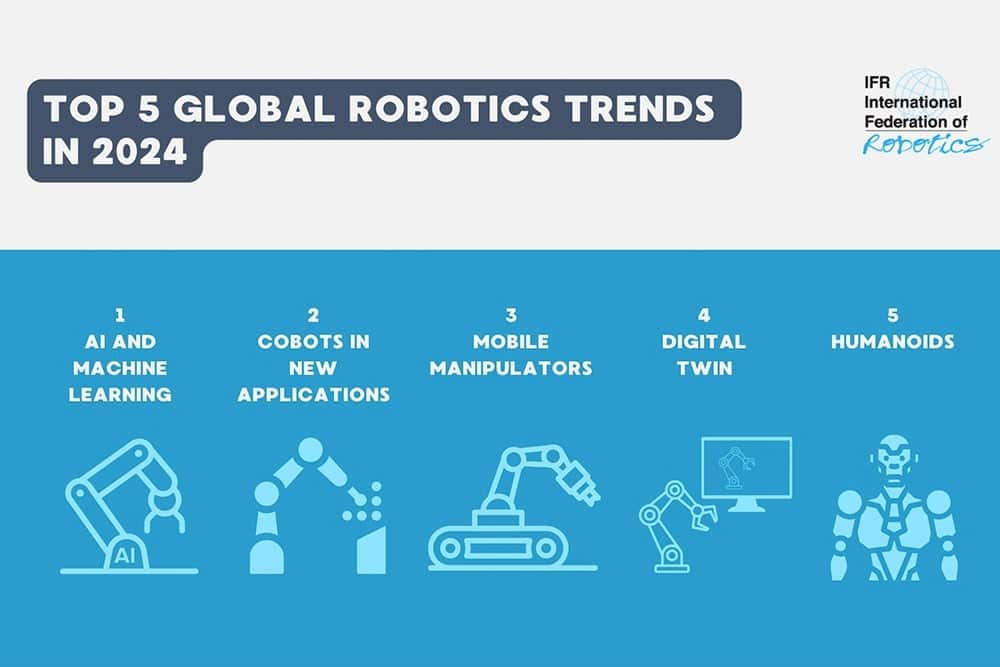
Mobile manipulators – known as ‘MoMas’ – automate material handling tasks. They combine the mobility of robot platforms with the agility of manipulator arms. This allows them to navigate complex environments and manipulate objects, which is crucial for manufacturing applications. Equipped with sensors and cameras, these robots perform inspections and maintenance tasks on machines and equipment. One of the key advantages of mobile manipulators is their ability to collaborate and support human workers. A shortage of skilled labour and a lack of people applying for factory jobs are likely to increase demand.
Digital twin technology is increasingly being used as a tool to optimise the performance of a physical system by creating a virtual replica. As robots become more digitally integrated into factories, digital twins can use their real-world operational data to run simulations and predict likely outcomes. Because the twin exists purely as a computer model, it can be tested and modified without safety implications, while saving costs. All experiments can be checked before the physical world itself is touched. Digital twins bridge the gap between the digital and physical worlds.
Robotics is witnessing significant advances in humanoids, designed to perform a wide range of tasks in different environments. Thanks to its human-like design, with two arms and two legs, the robot can be used flexibly in working environments that are actually made for humans. It can therefore be easily integrated into existing warehouse processes and infrastructure, for example. The Chinese Ministry of Industry and Information Technology (MIIT) recently published detailed targets for mass production of humanoids by 2025. The MIIT predicts that humanoids are likely to become a disruptive technology, comparable to computers or smartphones, which could change the way we produce goods and the way people live.