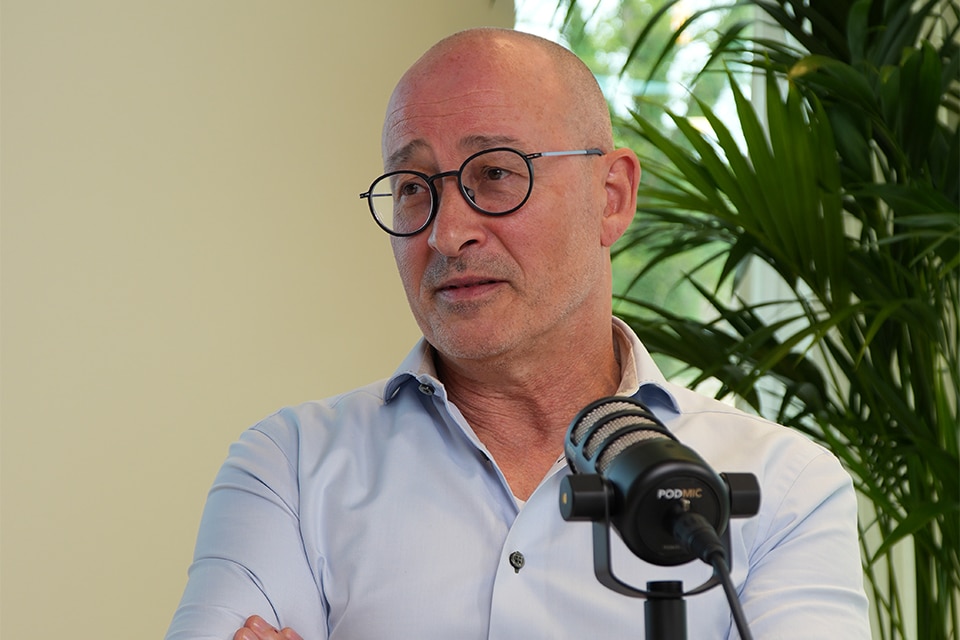
[00:01] Introducing the episode on connectivity
Björn Crul: Welcome back to this podcast series on the energy transition and the evolution towards smart and sustainable buildings. In the previous episode, we delved into the added value and operation of energy management systems. In this third podcast, we are going to focus on connectivity. And that, of course, is the indispensable basis for everything communication, control and monitoring. A strong and well-thought-out infrastructure is an absolute necessity today, both for residential and tertiary buildings. My name is Björn Crul and today I get to delve into connectivity together with one of Cebeo's experts, Alain Heymans. Hello Alain, welcome.
Alain Heymans: Good day.
Björn Crul: Alain, connectivity may sound a bit abstract to many people. So what are we actually talking about and why is it so important in sustainable and smart buildings?
Alain Heymans: When we look at connectivity within residential homes, it is absolutely important to have a good network. To have a stable network, to have a network built out with high-performance cabling. And that cabling in turn actually provides good communication to energy management platforms. And we see that happening more and more today, even within residential homes where charging stations, for example, have an application. And that is something we definitely want to monitor.
[01:19] Fibre to the Home and high-performance networks
Björn Crul: Network operators are also capitalising on this with their Fibre to the Home technology.
Alain Heymans: That's right, yes. So the connection to the outside is very important of course to keep those communications flowing smoothly. And for that, Fibre to the Home is a perfect tool. Today, Fibre to the Home is actually being fully rolled out nationwide. That ensures that a fibre connection gives a performance that is unprecedented, with the bandwidth we need to let those communications flow smoothly.
Björn Crul: And then if a builder is going to invest in his home with structured cabling and with such a fibre connection, what does that actually deliver?
Alain Heymans: It ensures that the last mile is completely covered. Before, we actually had a connection to the buildings that was previously limited in bandwidth. That limitation has therefore been completely removed. You should know: inside the building, a network connection is not only a wired connection, which still gives the best performance, but also a lot of devices are connected wirelessly. This wireless communication must of course also be able to flow, and a fibre-optic network is the perfect medium for this.
[02:33] Connectivity in residential projects
Björn Crul: And if you then want to do that in a good way, how is such a residential project approached today?
Alain Heymans: To build a good residential project, it is important to analyse the customer's needs. So talking to the customer, seeing where network connections are needed, in what way we can build them via a certain technology, via a certain topology of the network as well. And then we make sure that the cabling actually has high performance and is future-proof.
[03:06] Connectivity in tertiary buildings
Björn Crul: Housing is being prepared for the future. This does not only apply to residential buildings. Actually, the whole tertiary market is also in an evolution towards more connectivity. What are the focal points there, specifically then for tertiary buildings?
Alain Heymans: The focal points for tertiary buildings lie mainly in how am I going to structure my network. The topology of the network is an absolute must in order to perfectly guarantee later expansions, for example. It also ensures that the cabling becomes flexible, more manageable and can therefore provide future-proof connections. The application of such a network can depend very much on the location. Take for instance a campus environment, which requires a totally different approach than cabling within the building. And let alone, for example, cabling for industrial applications, where we have to take into account different environmental factors.
[04:09] Cebeo's role within connectivity
Björn Crul: In that market, there are a lot of innovative products right now. How do you position yourselves as Cebeo in that story?
Alain Heymans: As Cebeo, we mainly focus on delivering the right products. What is important for us to create added value in that segment is that we guide customers, give the right advice and we do that by transferring knowledge to those customers. We have a department that focuses specifically on everything communication, which is the Datacom department. And in addition, we now have a new business unit dedicated to data centres.
[04:52] Panduit FMPS and innovative power solutions
Björn Crul: Yes, we will talk a bit more about what you are doing around data centres in a moment. What also caught my eye: Panduit stands out with a new development, Panduit DC Power. Why is that an important product? What makes that innovative?
Alain Heymans: Well, when we talk about the Panduit solution, we are actually talking about FMPS, which is Fault Managed Power System. And that actually combines the safety of a low-voltage system with the ability to supply significant amounts of power over longer distances. With this, Panduit is setting a new standard. A standard that we see more and more coming today because of the demand for more consumption of power.
[05:35] Data centres and the role of Cebeo
Björn Crul: You just referred to it Alain, data centres are a very specific niche within these tertiary buildings. Cebeo has built up a very strong position in that segment as a partner of developers and installers. Why did you actually decide to form a separate business unit for this?
Alain Heymans: Well, we have done a market analysis. And that market analysis showed that the demand for supplying products and solutions is getting shorter and shorter, because the lead time for a data centre is also getting shorter and shorter. And we as a distributor can play a very big role in that. So our logistics services are actually our spearhead when we look at data centres. And given that the demand for data centres is increasing about 10 to 12% annually, we think we can play a very big and important role there.
[06:30] Data centre efficiency and sustainability
Björn Crul: It also has to do with the fact that those kinds of customers are looking for total solutions. Say, going from door security to ensuring connectivity?
Alain Heymans: That's true, but not only that. Efficiency within the data centre is also one of the key items a data centre faces. It is also reporting at European level to see how we can increase our power efficiency.
Björn Crul: Data centres need to become more sustainable, that's basically what it comes down to.
Alain Heymans: It does indeed come down to that and that is quite a challenge. We know that power demand is rising, cooling demand is rising and new cooling solutions are rising. So basically the energy demand is always rising. Energy efficiency is becoming more and more important and more difficult to control. For that, of course, the different tools exist. We can now build out management platforms that are also going to increase connectivity with the BMS system, so the Building Management System, where we get a total view of the energy consumption and also the cooling capacities of a data centre. Not only that, capacity management is also woven into it. Actually, everything is managed and reporting to, for instance, the IT manager or also facility manager can be better established.
[08:04] Brand-independent solutions and partners
Björn Crul: It actually becomes a more complex set of all kinds of factors that are taken into account and have to be managed on a global level. It seems to me that you have a special position there, also because Cebeo works brand-independently.
Alain Heymans: Yes, we can fortunately also provide a service that is multivendor. So we actually have a wide range of different partners who are actually leaders in this market. They in themselves bring solutions that are innovative and obviously look at energy efficiency. We also go down a full path with them together with the end customer. In the ecosystem within a data centre, it is important that each player actually fulfils its own role. And obviously together with our partners we can bring those solutions to the customers.
[08:56] Connectivity and data centre solutions at Cebeo Technology
Björn Crul: Talking about those partners and their innovative solutions. The Cebeo Technology trade fair is just around the corner. What innovative solutions will we find there around connectivity, fibre and data centre infrastructure?
Alain Heymans: We have a separate spot at Technology with Datacom and Datacenter. We have the possibility to show the FMPS system for Datacom, for example. We are going to link that to, for example, an active network camera, but also a wireless system which then actually has more of an industrial application, so that we have actually immediately also made the link between network and industry. As far as the data centre theme is concerned, at our stand we will actually show all possible applications that are smart in a data centre, such as access to a cabinet, but also the monitoring of power via the PDU, intelligent PDUs that are connected to the system and that can actually monitor the power perfectly via a management platform. In addition, connectivity within the data centre is also important and so we actually have high density fibre solutions with pre-terminated cabling systems.
Björn Crul: That as far as your own stand is concerned, but there are also a number of partners present.
Alain Heymans: Around the Datacom and Data Centres stand we actually have all our partners and all our stakeholders sitting around it. So all our partners who have something to do with Datacom or data centre are actually sitting around it.
[10:39] Closing of the podcast series
Björn Crul: The time to be inspired, then, dear listeners. If you want to discover it all, you should be at the Heysel in Brussels between 2 and 4 June for Cebeo Technology. Alain Heymans, thank you for this talk. And if you want to delve further into energy management systems or learn more about the energy transition and its impact for installers, I would like to invite you to listen to the other podcasts in this series as well.