nexttech.be
en

The knowledge platform for technology, innovation and digital transformation

We have not started the decade as we expected. Instead of celebrating economic growth and prosperity, manufacturers have gone into survival mode because of the logistical consequences of the coronavirus. These include an unstable supply chain, transportation problems, labour shortages and inflation.
Meeting these new challenges required accelerating digital transformation initiatives. Technologies such as cloud computing, robotic process automation and low-code development are at the heart of this digital evolution, offering manufacturers endless opportunities to explore new solutions. But what does this digital evolution mean for the year ahead? Here are the seven trends at the heart of the manufacturing industry in 2022.
Consumer demands change as fast as technology evolves, making it difficult for manufacturers to deliver the products and services in demand at the time. Customers expect same-day delivery, personalised products and services, and transparent delivery processes. This means that if a company wants to differentiate itself, it needs a high degree of flexibility and agility, something traditional business models are not designed to do.
In contrast, consumer-driven production focuses precisely on anticipating the needs of those who use the products. But how do you do that? By integrating new technologies and capabilities - such as data analytics, the Internet of Things (IoT) and artificial intelligence (AI) - into existing systems and software.
Manufacturers now face large fluctuations in supply and demand. According to Deloitte procurement managers still face complications due to high consumer demand, rising costs of materials and transportation, and slow deliveries.
Disruptions are common and costly, but many manufacturers are working on models to make supply chains and logistics more predictable. Replacing manual tasks with technologies such as AI, data analytics and sensors can help supply chain managers identify patterns, predict procurement needs and better manage inventories. According to Deloitte, digital supply networks and data analytics can help respond to disruptions flexibly and in different ways.
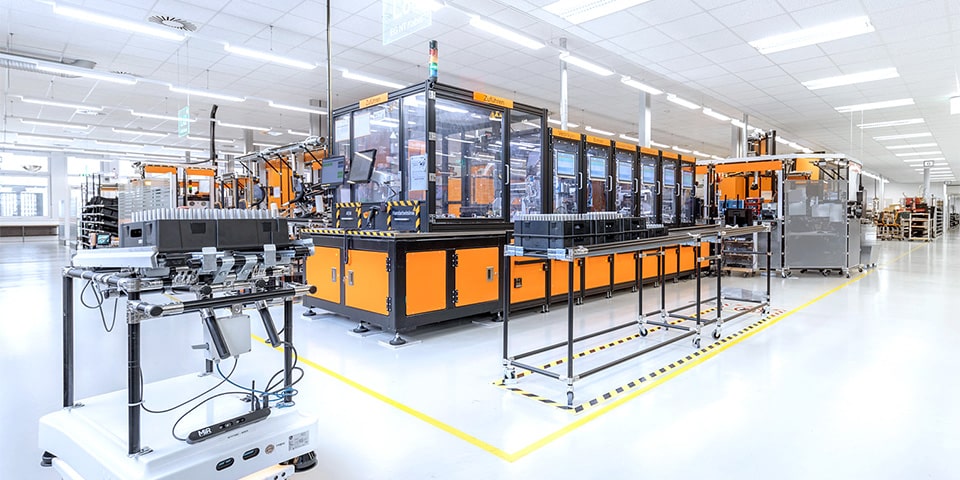
Smart factories use highly automated equipment and machinery to produce as efficiently and flexibly as possible. Sensors monitor products and stocks, while cloud-controlled machines and equipment provide real-time insight into maintenance needs.
A great example is the smart factory of Adidas. Here, it uses 3D printers, robotic arms and IoT tools to quickly create mockups and digital replicas. Being able to print prototypes quickly allows Adidas to better respond to changing consumer demand and shorter lead times.
The development of smart factories is driven by the development of new technologies. In trend 4, 5 and 6, we will elaborate on this and look at the three main trends in smart factories.
We are living in the fourth industrial revolution, also known as Industry 4.0. Whereas the third industrial revolution brought us the first digital technologies, Industry 4.0 is distinguished by technologies such as hyper-automation, IoT, smart factories and big data. These advances have created a global economy based on digital technologies.
According to TechTarget the fourth industrial revolution builds on the digital revolution, as technologies continue to bridge the gap between the physical and cyber worlds. Technology is evolving rapidly and manufacturers have endless opportunities to adapt business models, improve their operations and perform tasks faster and better.
The digital economy consists of companies, products and services that would not exist without modern digital technologies. Think of organisations like Netflix, Airbnb and Uber. And as technology evolves, the competitive landscape also shifts. For example, look at US video store chain Blockbuster Video. Netflix was ahead of the digital curve by offering streaming services, while Blockbuster lagged far behind. Today, only 90s youth remember Blockbuster, while everyone seems to have a Netflix account.
In the manufacturing industry, for example, we see the digital economy in the field of medical devices. Blood glucose meters used to be analogue devices without internet connectivity. Now, most of these devices are fully connected to the digital world. Manufacturers can get better insights, users can monitor their health and healthcare providers can better meet the needs of their patients.
New technology improves business processes, but it also changes what manufacturers can offer their customers. More and more companies no longer focus on the product, but on the customer's needs. These companies do not sell a specific product but a predetermined output, with all the services that go with it. We call this development servitization and is driven by technological developments such as the increasing ability to offer connected services.
Connected services provide complementary offerings for internet-based products, such as medical devices, vehicles, hand tools, machinery and even turbines. Capgemini analysed connected services in the manufacturing industry and wrote: “We see business models shifting towards pay-per-use and pay-per-output, where customers pay not for the product itself, but for the benefits the product delivers.”
The possibilities of connected services are endless. Some well-known examples include remote control of equipment and machinery, predictive maintenance and smart home solutions.
Offering connected services creates a better customer experience and the opportunity for manufacturers to differentiate themselves from the competition. Data collected at every point in the customer journey can be used to continuously improve the quality of products and related services. In addition, connected services also create stable revenue streams and higher margins.
According to Gartner hyperautomation is one of the key technology trends for 2022. Hyperautomation is a business-driven and disciplined approach to quickly identify, map and automate as many business and IT processes as possible. Hyperautomation is driven by technologies such as AI, low-code development platforms and business process management (BPM) tools.
The manufacturing industry often operates in silos and many organisations still lean on manual and time-consuming processes. Hyperautomation takes tasks performed by humans out of their hands and makes operations more transparent. While technology handles repetitive but crucial workflows, employees can focus on more complex tasks, such as driving innovation.
Manufacturers today are expected to be able to deliver products very quickly and on a large scale worldwide, which inevitably puts pressure on the environment. The World Economic Forum reports that the European manufacturing industry emits 880 million tonnes of CO2 annually. This is because manufacturers have traditionally followed a linear take-make-waste model, which relies on fossil fuels, overproduction and excessive amounts of waste. But more and more manufacturers are moving to a circular economy, a sustainable model that optimises efficiency at every stage of production.
The circular economy uses technologies such as AI and machine learning to automate processes, streamline operations and increase efficiency. Recycling, refurbishing and remanufacturing processes are applied within each production phase to reduce waste and cut costs, thereby reducing a company's carbon footprint. Digitising processes also provides real-time insights based on which quick decisions can be made so that manufacturers can continue to meet their sustainability targets.
It is clear that factories must undergo a digital transformation by 2022. In this, speed and flexibility are essential. However, the transformation to a hyper-connected, digital-first organisation cannot be achieved overnight. Digital transformation in itself is a considerable challenge for any business, especially for manufacturers with many manual processes and outdated systems. But with tools like AI, low-code software development and multi-experience platforms, the transformation process can be accelerated. For the manufacturing industry, there are challenges here in 2022, but above all opportunities to also benefit from the digital economy.